When an employee leaves, the last workday is not always the end of the security process. A commercial rekey after employee termination gives your business control over who can enter the building, restricted rooms, storage areas, and other spaces protected by mechanical keys. It is a practical step that can prevent an old key from becoming a future problem.
For businesses in Ballwin, Chesterfield, Wildwood, Town and Country, and throughout West St. Louis County, rekeying can often be completed on-site with far less disruption than replacing every lock. The right response depends on the employee’s role, the keys they held, the condition of your existing hardware, and how your business manages access overall.
Why rekey after an employee leaves?
Keys are easy to copy, hard to track, and often passed around more than management realizes. Even a dependable former employee may have made a spare for a family member, handed a key to a coworker, or misplaced one without reporting it. A key that was issued years ago can remain in circulation long after the person who received it has moved on.
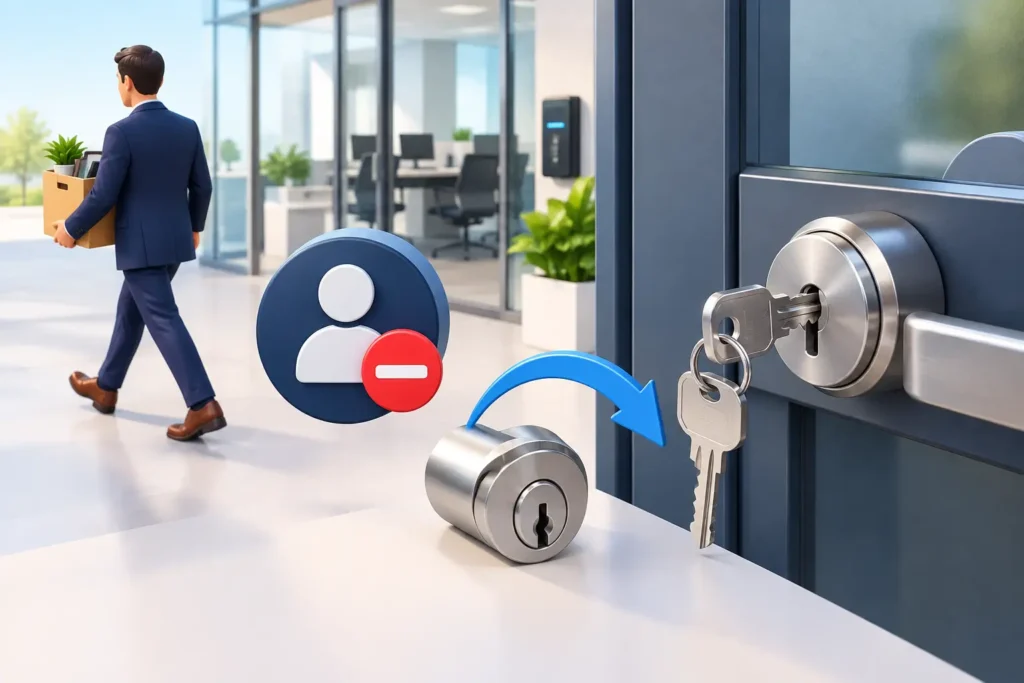
Rekeying changes the internal pin configuration of an existing lock cylinder so the previous key no longer works. Your doors keep the same exterior hardware, but they operate with new keys. This is usually a more efficient and cost-conscious solution than replacing a lock that is otherwise in good working order.
The goal is not to assume the worst about every departing employee. It is to maintain a consistent security policy. Applying the same access-control procedure after every departure protects the business, avoids uncomfortable exceptions, and gives managers a clear record of what was done.
When commercial rekeying is the right move
A rekey is often appropriate when a former employee had a physical key to an exterior door, office, stockroom, records room, server closet, cash area, warehouse, or mailbox. It is especially sensible after an involuntary termination, a dispute, an unreturned key, or a departure involving management-level access.
It also makes sense when a key belonged to someone who had access to a master key system. One master key may open multiple doors, so losing control of it can affect far more than a single entrance. A locksmith can assess the current key hierarchy and explain whether a targeted rekey, a broader system update, or a new master key plan is the better choice.
There are situations where rekeying alone is not enough. If a lock is worn, damaged, outdated, or not appropriate for the door, replacement may be the better long-term answer. A business that has experienced repeated key-control issues may also benefit from restricted keyways, electronic access control, or a combination of mechanical and electronic security.
Start with the access, not just the front door
The front entrance is the obvious place to begin, but it should not be the only door considered. Before scheduling service, review where the employee could enter and which keys or credentials they received. This may include rear delivery doors, employee entrances, interior offices, maintenance rooms, gates, storage cages, file cabinets, and shared commercial suites.
Managers should also check for less obvious access points. Was the employee issued a key to a landlord-controlled common area? Did they have a keypad code, alarm code, garage remote, smart-lock credential, or access card? Rekeying a door will not cancel those other forms of access, so each system needs to be handled separately.
For a small office with one or two exterior doors, the process may be simple. For a medical office, restaurant, retail store, warehouse, or multi-tenant property, access can be more layered. A careful review before the locksmith arrives helps avoid missed doors and keeps the work efficient.
Rekeying versus replacing commercial locks
Commercial rekeying is generally the right solution when the existing lock hardware is secure, compatible, and functioning properly. The locksmith removes or services the cylinder, changes the pin combination, tests the lock, and provides new keys. The old keys are then inactive for that cylinder.
Replacing the lock may be necessary if the hardware is failing or if the business needs a different level of security. A door that does not latch correctly, has a loose lever, binds in the frame, or lacks a suitable deadbolt may need more than a cylinder change. On exit doors, code-compliant panic hardware and door operation must also be considered. Security should never come at the expense of safe emergency egress.
The choice can also come down to future planning. If your locks have accumulated mismatched keys over time, an employee termination may be a good opportunity to put the building on a cleaner key system. One properly designed key plan can reduce the number of keys staff carry while limiting access to sensitive areas.
Protect key control after the rekey
A rekey provides a fresh start, but the result depends on what happens next. New keys should be issued only to people who need them, and each key should be documented. Avoid marking keys with a business name, suite number, or address. If a key is lost, that information can make it much easier for the wrong person to identify the door it opens.
Keep a simple record showing who received each key, the date issued, and which doors it opens. When an employee changes roles or leaves, collect the key and compare it with the record. This process does not need to be complicated, but it should be consistent.
For businesses with several employees or departments, consider assigning different levels of access. A staff member may need an exterior entry key and a work-area key, while a manager needs access to offices and secure storage. This is where a master key system can be useful. It gives designated managers broader access without giving every employee a key to every door.
Schedule service with business operations in mind
A termination can create an immediate need, particularly when keys have not been returned or there is concern about a former employee coming back. In those cases, prompt mobile locksmith service can help restore control quickly.
Not every situation requires an after-hours response, though. If the former employee returned all keys, had limited access, and the business has other security controls in place, rekeying can often be scheduled during a quieter part of the day. Retail stores may prefer service before opening or after closing. Medical offices may need work completed between appointments. Warehouses may need to coordinate around receiving hours and active loading doors.
A professional locksmith should explain what can be rekeyed, identify hardware concerns before work begins, and provide clear expectations about keys, master-key changes, and any recommended repairs. That clarity matters when a business is trying to maintain security without interrupting customers, patients, tenants, or staff.
A practical checklist for employee departures
A written offboarding procedure keeps security from becoming an afterthought. After collecting company property, confirm the return of physical keys, access cards, remotes, alarm fobs, and any device used to manage smart locks or access control. Disable codes and credentials promptly, then decide whether the physical locks should be rekeyed based on the access the employee held and whether key control is certain.
Document the decision even when a rekey is not needed immediately. That record helps property managers and business owners understand the current security status of each location. It also makes the next staffing change easier to handle.
Local commercial locksmith help when access changes
Commercial properties do not all use the same doors, locks, or key systems. A retail storefront in Kirkwood may have a different setup than a warehouse in Fenton, a professional office in Creve Coeur, or a medical practice in Ladue. The best approach is one that fits the building, daily operations, and level of access that needs to be controlled.
Locks R Us Locksmith provides mobile commercial locksmith service throughout Ballwin and surrounding Greater St. Louis communities, including rekeying, lock repair and replacement, master key systems, panic bars, door closers, and commercial door hardware. A technician can assess the existing setup at your location and help you make a practical decision without replacing hardware that still has useful life.
Employee transitions happen in every business. Treating keys and access credentials as part of the offboarding process helps protect the people, property, records, and inventory your business works hard to maintain.